In This Issue
|
|
|
New Video: I Tested GPT 5.6 Sol vs Fable 5. What You Need To Know.
Nate ran the two newest models (GPT-5.6 Sol and Fable 5) side by side on real work all day. His takeaway: Fable is the better manager and Sol is the better worker. Fable wins on creative planning and strategy, while Sol is faster, far cheaper, and stronger at execution and high-volume tasks. The mistake most people make: It's tempting to pick one "best" model and route everything through it. That either burns money running a premium model on simple tasks, or hits a wall when a cheap model can't handle the hard, ambiguous ones. How this helps you: You'll know how to split the work: let Fable frame the tricky, open-ended problems, then hand the repeatable execution to Sol. Judge by cost per finished result, not the benchmark rank. That's how you build faster without overpaying.
|
|
|
Winning Is All We Do They turned a 120-hour reporting slog into a 1-hour job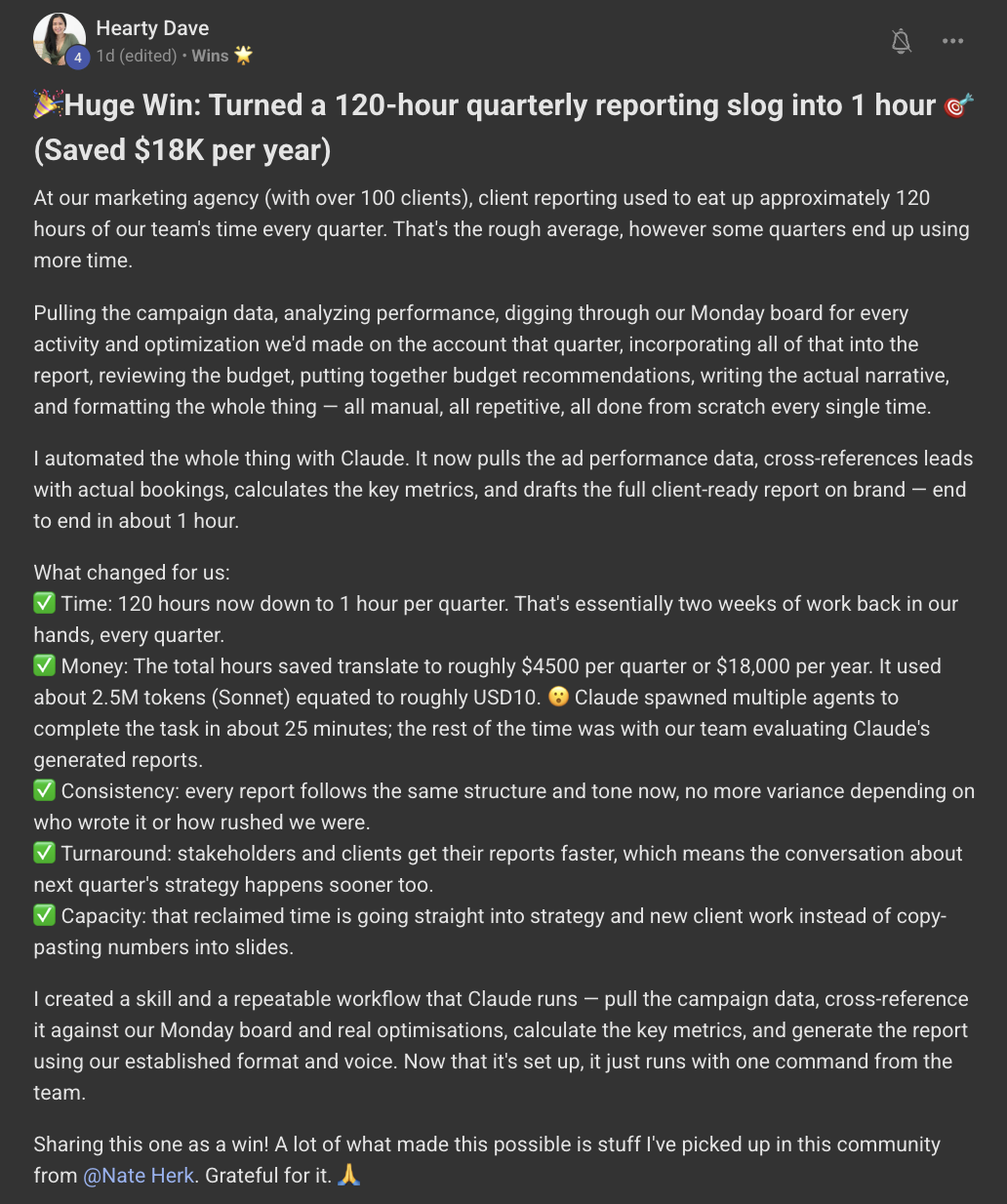
What happened: One AIS+ member runs a marketing agency with over 100 clients, and client reporting used to eat about 120 hours every quarter. Pulling the campaign data, digging through the project board, reviewing budgets, writing the narrative, formatting the whole thing (all manual, all from scratch, every time). They built a skill and a repeatable workflow that Claude runs. Now it pulls the data, cross-references leads against real bookings, calculates the metrics, and drafts the full client-ready report on brand. End to end in about an hour. The agents did the heavy lifting in roughly 25 minutes for around $10 in tokens, and the team spent the rest of the time just reviewing. That's about $4,500 saved per quarter, or $18,000 a year. The opportunity for you: The real win isn't the report, it's what they did with the time they got back. Two weeks of work per quarter went straight into strategy and new client work instead of copy-pasting numbers into slides. Find the one task you dread rebuilding from scratch every cycle, turn it into a skill Claude can run on command, and you buy back time you can actually sell. This is one of many success stories from AI Automation Society Plus. If you're not a member, you're missing out.
|
|
|
In the News ChatGPT can now do the whole job, not just talk about itThe news: OpenAI launched ChatGPT Work on July 9, an agent that takes one request and completes an entire multi-step project on its own. It works across your apps and files, runs for hours while you're away, and hands back finished spreadsheets, slides, docs, and even web apps. It runs on GPT-5.6, the same new model Nate puts to the test in this week's video. How it affects automation: This is the exact shift you're already learning to build: agents that execute, not just answer. The tools are converging on autonomous, multi-step work, so the skill that pays is knowing how to design and direct these agents (exactly what you practice in n8n and Claude Code). |