
In This Issue
|
|
|
New Video: I Tried 100+ Claude Code Skills. These 6 Are The Best
After 400 hours in Claude Code and real client work across real estate, HVAC, coaching, and marketing agencies, 6 skills keep showing up as what businesses actually pay for. Not the flashy demos you see on YouTube. The boring ones that save time, save money, or remove mistakes. This video breaks down all 6, why each one sells, and how they stack together into a repeatable client-ready workflow. The mistake most people make: They spend months getting good at impressive skills nobody is paying for. Businesses across every industry face the same problems. They want reliability and results, not a cool demo. If you are picking skills based on what looks interesting instead of what the market is already paying for, you are building the wrong thing. How this helps you: You will know the exact 6-skill stack to start with, the order to learn them, and how to frame each one as an outcome for a client. If you want to sell AI automations in 2026, this is the shortest path from zero to client-ready.
|
|
|
Winning Is All We Do First Real Client, Landed by Building a Custom AI OS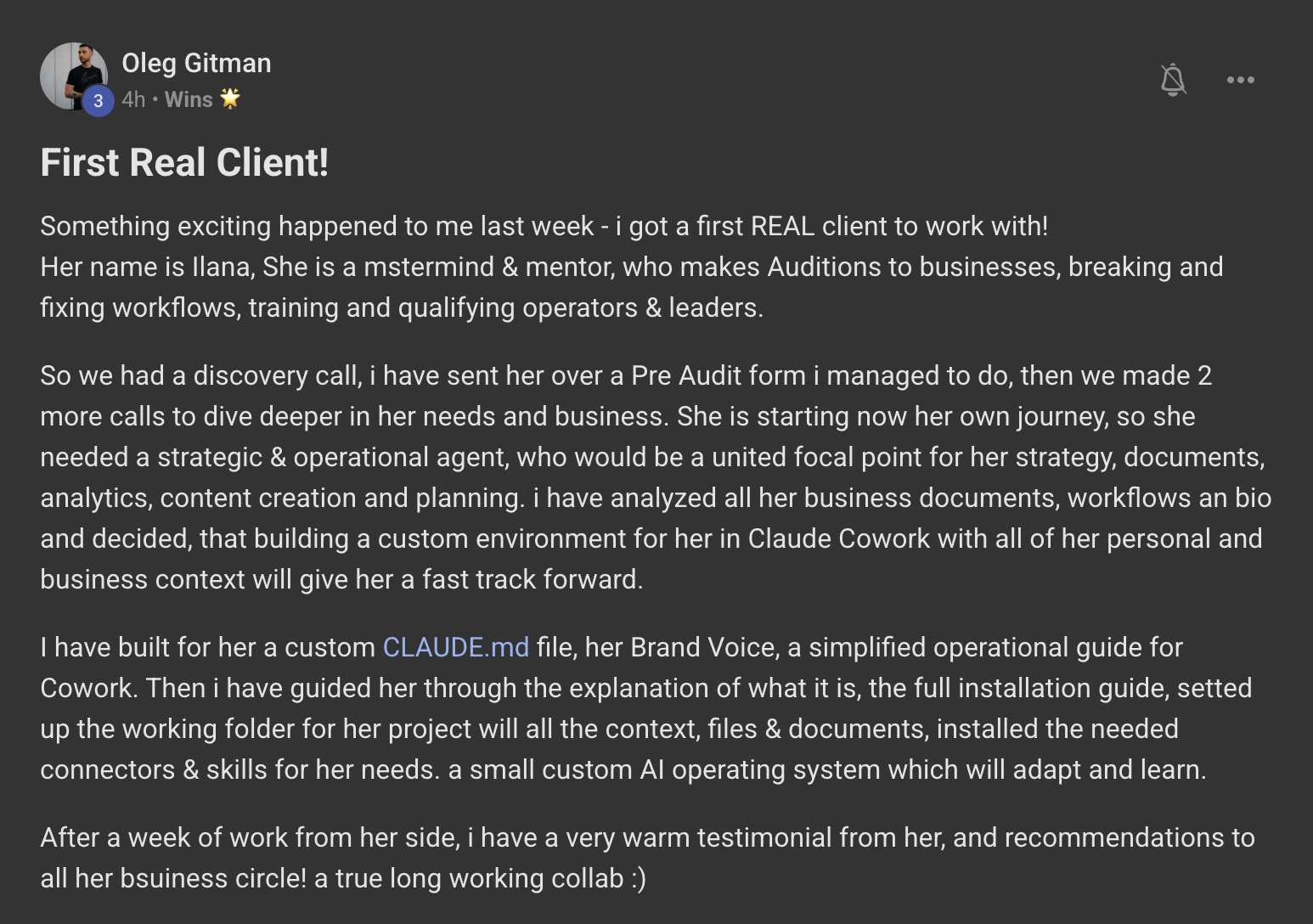
What happened: Oleg's client Ilana is a mastermind and mentor who needed a central AI system for her strategy, documents, analytics, content creation, and planning. He ran a discovery call, sent her a pre-audit form, did two follow-up calls, and then built her a custom environment in Claude Cowork. That included a custom CLAUDE.md file, a Brand Voice document, a simplified operational guide, and all her business documents, workflows, and connectors installed and configured for her specific needs. One week of work from her side, and she came back with a warm testimonial and recommendations to her entire business circle. The opportunity for you: Coaches and mentors with active client bases need a central AI system they can actually run their business from. Most of them do not know where to start. If you can show up with a structured onboarding process and a working setup, that is a high-value service they will pay for and refer you from. This is one of many success stories from AI Automation Society Plus. If you're not a member, you're missing out.
|
|
|
In the News OpenAI's New Codex Feature Lets You Set a Goal and Walk AwayThe news: OpenAI just shipped /goal in Codex CLI 0.128.0. You give the agent a durable objective, and it keeps working toward it across turns, interruptions, and even token budget boundaries. One developer typed "/goal ship the 18 features in BACKLOG.md before standup," closed his laptop for 18 hours, and came back to find 14 of the 18 features shipped with PRs already opened and self-reviewed. The agent paused itself when it hit budget limits, summarized where it left off, and handed back control cleanly. How it affects automation: The difference between a prompt and a goal is state. A prompt is a one-time instruction. A goal is a persistent commitment the agent holds until the work is actually done. If you are building automations or selling AI services, this changes what "handing off to an agent" looks like. You can now define an outcome, not just a next step, and trust the agent to figure out the path. That is a meaningful shift in how much you can delegate. |