In This Issue
|
|
|
New Video: Build & Sell AI SaaS Products (2 HOUR COURSE)
I open an empty folder with no idea and close with a working product that takes payments on a real domain. I run the whole build through six steps I call the six P's: pain (find a problem people will pay to remove), promise (one sentence on the landing page), product (plan it, build it, test it), plumbing (payments, login, database), packaging (brand and colors that look bought instead of homemade), and proof (verify all of it). The product I land on turns a plain description of a client into finished consulting deliverables (proposals, audits, branded decks). I also run two coding agents in the same project folder at once, Claude Code as the thought partner and Codex as the executor, and I dictate instead of typing so the keyboard is not the bottleneck. The mistake most people make: Building first and validating second. My rule is to sell before you build: put a rough demo in front of someone, ask what they would actually pay, and get a yes before you write a line of code. The second mistake is handing over your judgment along with the work. I do not read Python, and I still act as the project manager who makes the agent prove it verified its own output. How this helps you: You get the whole path from empty folder to paid product, including the parts tutorials skip (checkout, login, the database, a custom domain). You also get the growth plan for after launch: get to 10 paying users, find out exactly why anyone leaves, then open the doors wider. Push to 50 before you understand the first 10 and you burn the audience you just earned.
|
|
|
Winning Is All We Do 108,000 subscribers, zero filming or editing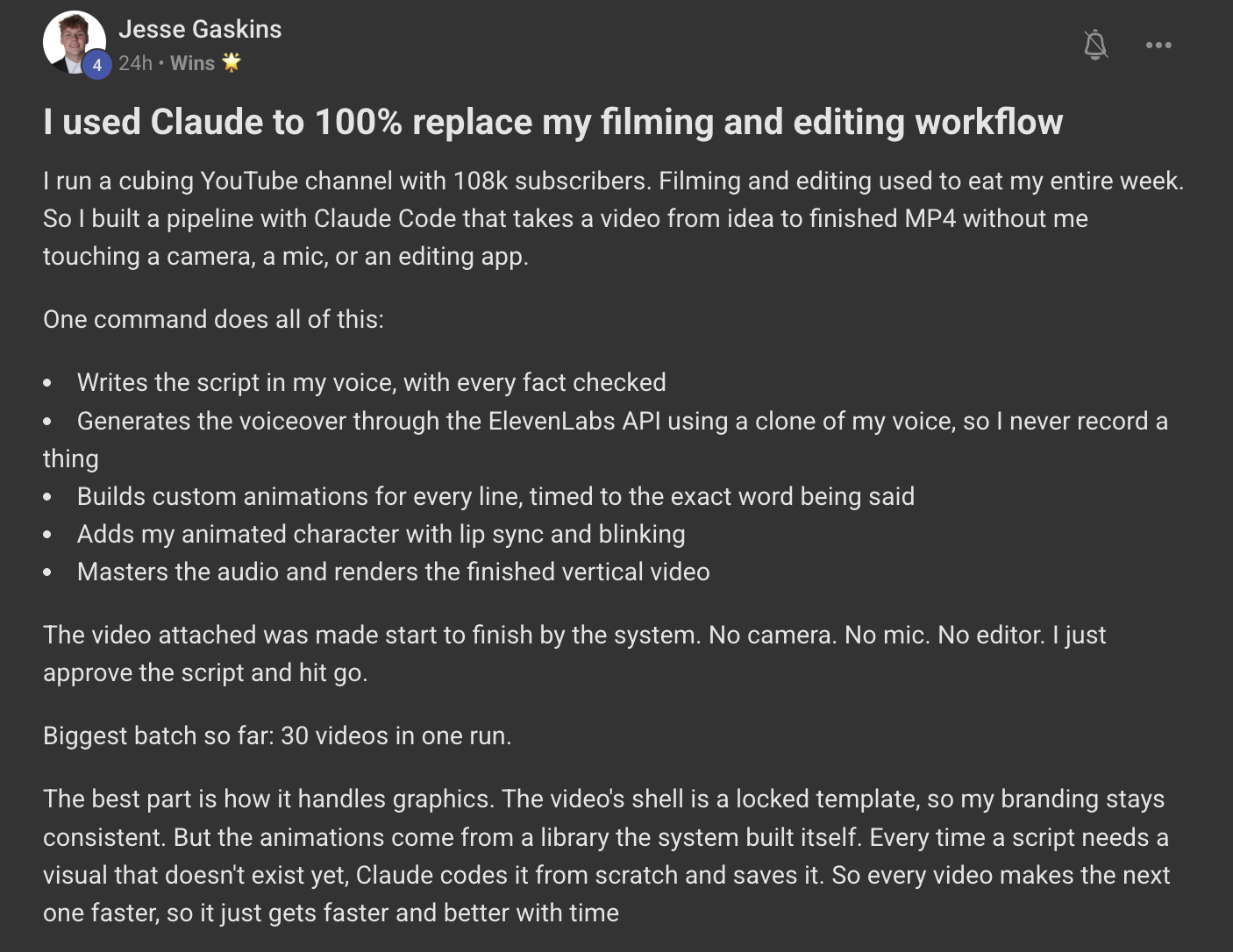
What happened: Jesse Gaskins runs a cubing YouTube channel with 108,000 subscribers, and filming and editing used to eat his entire week. He built a Claude Code pipeline that takes a video from idea to finished MP4 with one command: it writes the script in his voice with every fact checked, generates the voiceover through the ElevenLabs API using a clone of his voice, builds custom animations timed to the exact word being said, adds his animated character with lip sync, then masters the audio and renders the vertical video. No camera, no mic, no editor. His biggest batch so far was 30 videos in one run. The opportunity for you: Every creator and brand with a content calendar is paying humans to do the exact steps Jesse automated, and most of them have no idea a pipeline like this is possible. Build one for a client and you are not selling video editing, you are selling a system that gets faster every time it runs (when a script needs a visual that does not exist yet, Claude codes it and saves it, so the animation library grows itself). This is one of many success stories from AI Automation Society Plus. If you're not a member, you're missing out.
|
|
|
In the News Cloudflare built a browser that humans cannot useThe news: Cloudflare launched Kitesurf, a cloud-hosted browser built only for AI agents. It throws out everything an agent never looks at (tabs, themes, extensions) and keeps what an agent actually needs: screenshots, HTML extraction, and form filling. In Cloudflare's own tests it used about three times less CPU and up to seven times less memory than Chromium on common agent tasks. It speaks the same protocol as Playwright and Puppeteer, so existing automations can point at it without a rewrite. It is free while in beta through Cloudflare's Browser Run, and Cloudflare says it went from decision to launch in 12 weeks. How it affects automation: The browser step is usually the most expensive and most fragile part of anything you build. When a page costs a third of the CPU to load, the scraping and form-filling jobs you already run get cheaper at volume, and the ones you passed on as too expensive start to pencil out. Note the other half of Cloudflare's announcement too: a browser driving an agent faces attacks a human browser does not, because a malicious page can feed instructions straight to your agent. Treat every page your agent reads as untrusted input. |