
In This Issue
|
|
|
New Video: How to Never Hit Your Claude Session Limit Again
This video walks you through every tool and habit for keeping Claude sharp across long sessions, from using the /re command to rewind failed attempts, to manually compacting at 12% usage instead of waiting for autocompact to fire at 95%. Nate also shares a custom token dashboard that shows exactly where your tokens are going by project, prompt, and tool call, so you can stop guessing and start making intentional decisions. The mistake most people make: Most people stay in the same session too long, letting the conversation balloon until Claude starts degrading (editing files without reading them, contradicting itself, losing track of the plan). By the time you notice context rot, you have already paid for thousands of tokens that are actively working against you. How this helps you: You will know exactly when to reset, what to save before you do, and how to chain sessions so nothing falls through the cracks. The result is faster output, lower token costs, and a Claude that stays sharp all the way to the finish line.
|
|
|
Winning Is All We Do A second discovery call and a wireframe demo, all in one week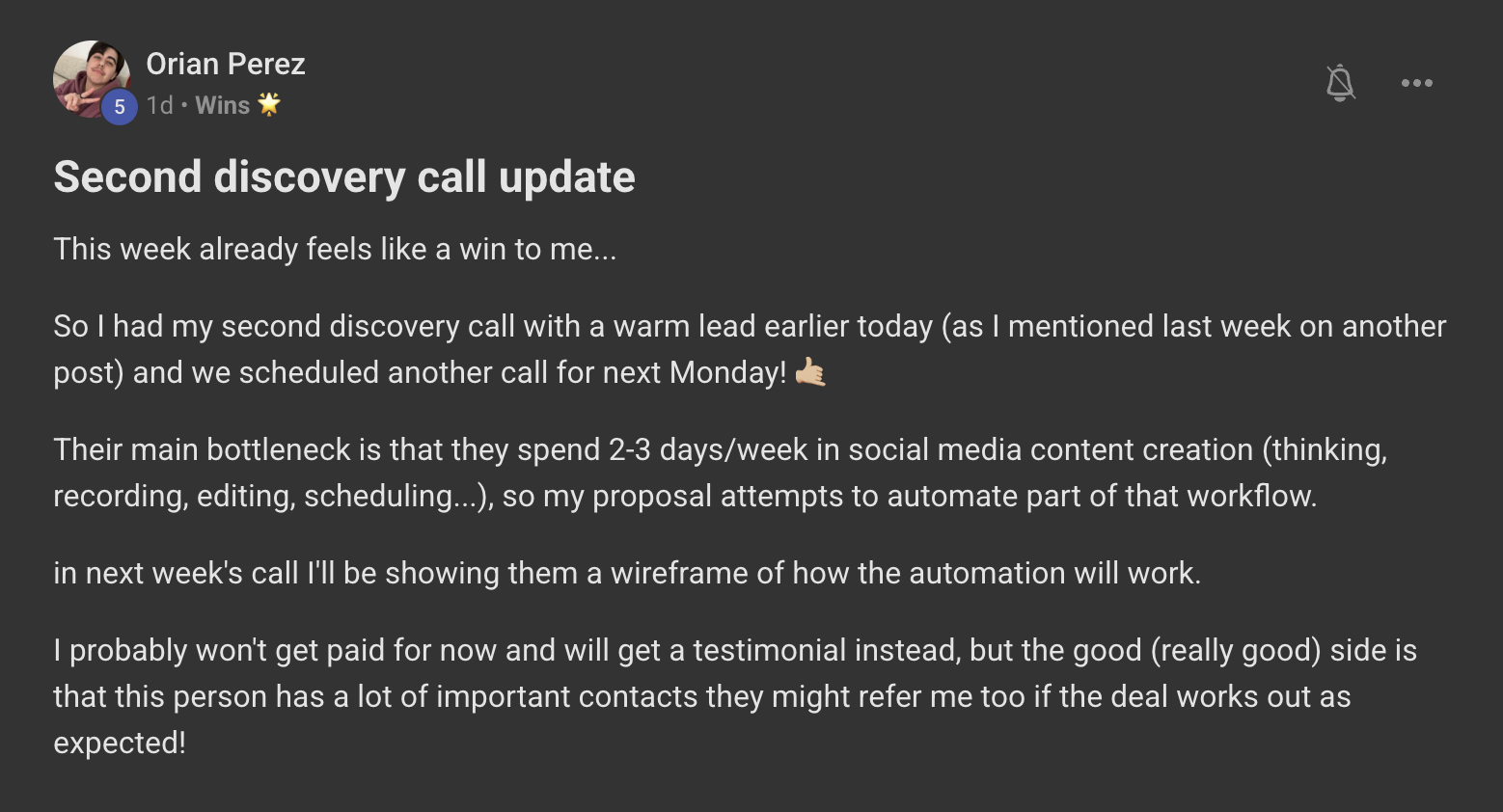
What happened: Orian Perez got on a second discovery call with a warm lead who spends 2 to 3 days per week on social media content (thinking, recording, editing, and scheduling). He pitched an automation solution to reclaim that time, and they booked a follow-up for next Monday so he can demo a wireframe of the workflow. If the deal closes, he expects a testimonial and referrals from a client with a strong professional network. The opportunity for you: Businesses that rely on manual social media workflows are everywhere, and they already feel the pain every week. You do not need a signed contract to have traction: a second discovery call means your pitch landed, and a wireframe demo is where deals get real. This is one of many success stories from AI Automation Society Plus. If you're not a member, you're missing out.
|
|
|
In the News OpenAI's New Image Model Can Finally Spell (and It's in the API Now)The news: OpenAI launched ChatGPT Images 2.0 on April 21, available to all ChatGPT and Codex users and through a new gpt-image-2 API. The model adds a Thinking mode that searches the web, self-checks its outputs, and generates multiple image variations from a single prompt. It also handles text rendering reliably for the first time (including non-Latin scripts), supports up to 2K resolution, and can produce eight images in one run. How it affects automation: The gpt-image-2 API means you can plug real image generation directly into your automations. If you are building with n8n or Claude Code, this is a new tool you can add to any pipeline where clients currently pay a designer for repetitive visual work like social graphics, marketing assets, or product mockups. |